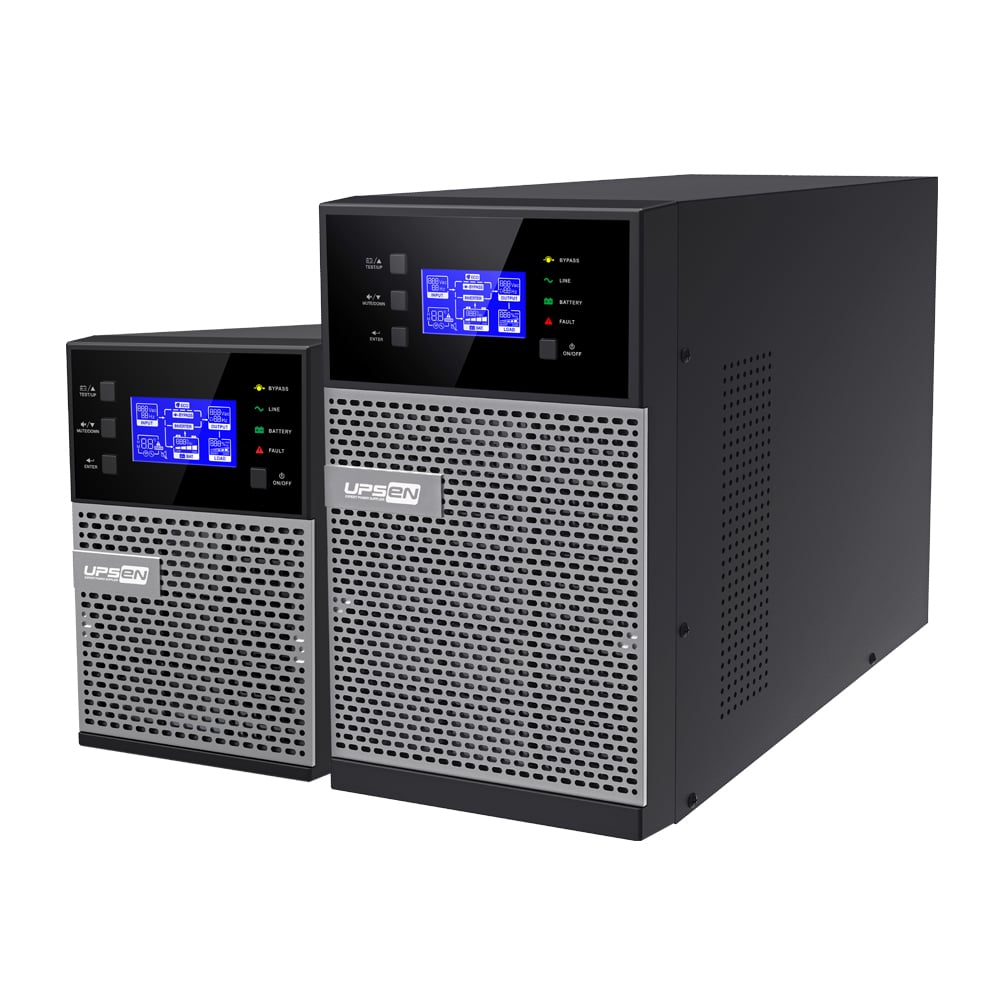
·High Reliability Design
Ultra-wide input voltage range 138~485Vac, no derating is used above 305Vac
·Energy Saving And Environmental Protection
High input PF value,up to 0.99,adopts three-level topology, and the efficiency of the whole machine is as high as 96.5%
·Parallel Redundancy Function
Parallel directly,6 units can be connected in parallel, supporting parallel sharing of battery packs
·Flexible Battery Configuration Scheme
The number of battery cells is 30~50,and the single machine has large capacity charging power to meet the backup demand of long delay.
·Super Load Capacity
The output power factor is 0.9,can carry 100%unbalanced load, the load adaptability is strong,can carry the pure inductive load and the capacity load close to full load
·Compatible With Generator Operation
The Power Walk In function reduces the inrush current of system startup and reduces the demand for generator capacity of the parallel system
·LBS Synchronization Function
With LBS synchronization function,realize the synchronization of two independent UPS systems,and provide system reliability
·Intelligent Management Function
Support RS485,SNMP,Dry contact,CAN interface
| Model | MS 600KVA | MS 800KVA | MS 1000KVA | MS 1200KVA | |
| Capacity | UPS Cabinet | 100-600KVA | 100-800KVA | 100-1000KVA | 100-1200KVA |
| Module | 100KVA | /100KW | |||
| Max.Module Number | 6 | 8 | 10 | 12 | |
| INPUT | |||||
| Input Method | Three-Phase Four-Wire+ Ground Wire | ||||
| Rated Voltage | 380/400/415VAC | ||||
| Voltage Range | 138~485Vac; 305~485Vac no derated load, 138~305Vac derated load | ||||
| Frequency Range | 40~70Hz | ||||
| Power Factor | ≥0.99 | ||||
| Input Current Harmonics | ≤3%(100% Linear Load) | ||||
| Bypass Voltage Range | Max.Voltage: 25% (Optional +10%, +15%,+20%); Min.Voltage: -45%(Optional -10%, -20%,-30%) Frequency Protection Range: ±10% |
||||
| Output | |||||
| Rated Voltage | 380/400/415VAC | ||||
| Power Factor | 1.0 PF | ||||
| Voltage Accuracy | ±1% | ||||
| Output Frequency | Mains Mode | ±1%/ ±2%/ ±4%/ ±5%/ ±10% of the rated frequency (Optional) | |||
| Battery Mode | (50/60±0.1%)Hz | ||||
| Load-to-Peak Ratio | 3:1 | ||||
| Overload Capacity | load ≤ 110%: Transfer to bypass mode after 60 min 110% < load ≤ 125%: Transfer to bypass mode after 10 min 125% < load ≤ 150%: Transfer to bypass mode after 1 min |
||||
| Output Voltage Distortion | ≤2% Linear Load; ≤3% Non-linear Load | ||||
| Efficient | |||||
| Normal Mode | ≥96.5% | ||||
| Transer Time | Utility to Battery : Oms; Utility to Bypass: Oms | ||||
| UPS Cabinet Communication interface | CAN, RS485, FE, LBS, Parallel, Relay card, SNMP card(Optional) | ||||
| Battery | |||||
| DC Voltage | Optional Voltage: 360V/384V/408V/432V/456V/480V/504V/528V/552V/576V/600Vdc(30/32/34/36/38/40/42/44/46/48/50pcs Battery Optional) (Default 40pcs(480VDC); No center line 36pcs to 50pcs(432VDC - 600VDC) - Output power remains unaffected (PF 1.0); 32pcs to 34pcs(384VDC - 408VDC) - Reduce the output power to 0.9 (PF 0.9); 30pcs(360VDC)- Reduce the output power to 0.8 (PF 0.8); |
||||
| Module Charge Current (A) Max. | 20A | ||||
| Protection | |||||
| Short Circuit | Hold Whole System | ||||
| Overheat | Line Mode: Switch to Bypass; Backup Mode:Shut Down UPS Immediately | ||||
| Battery Low | Alarm and Switch off | ||||
| Self-diagnostics | Upon Power on and Software Control | ||||
| EPO | Shut down UPS immediately | ||||
| Battery | Advanced Battery Management | ||||
| Noise Suppression | Complies with EN62040-2 | ||||
| Display | |||||
| Audible & Visual | Line Failure, Battery Low, Overload, System Fault | ||||
| Status LED | UPS Fault, Alarm and normal | ||||
| Reading on the LCD | Input Voltage, Input Frequency, Output Voltage, Output Frequency, Load Percentage, Battery Voltage, Parameter Set, History Record | ||||
| Working Environment | |||||
| Operating Temperature | 0℃~40℃ | ||||
| Relative Humidity | 0~95% Non-Condensing | ||||
| Stored Temperature | -25℃~55℃ | ||||
| Altitude | <1500m | ||||
| Noise(Db) | 70(1m) | ||||
| Physical Characteristics | |||||
| UPS Cabinet W*D*H(MM) | 800*1000*2000 | 1800*1000*2000 | |||
| Cabinet Packing Size W*D*H(MM) | 1000*1200*2170 | 2000*1200*2170 | |||
| UPS Cabinet N.W. (KG) | 440 | 720 | 760 | 780 | |
| UPS Cabinet G.W. (KG) | 540 | 820 | 860 | 880 | |
| Power Module W*D*H(MM) | 440*750*131 | ||||
| Power Module Packing Size W*D*H(MM) | 580*1000*250 | ||||
| Power Module N.W.(KG) | 50 | ||||
| Power Module G.W.(KG) | 55 | ||||
| Executive Standard | CE,EN/IEC 62040-3,EN/IEC 62040-1-1 | ||||
| *Product specifications are subject to change without further notice | |||||
Megawatt-Scale Protection That Grows with Your Load
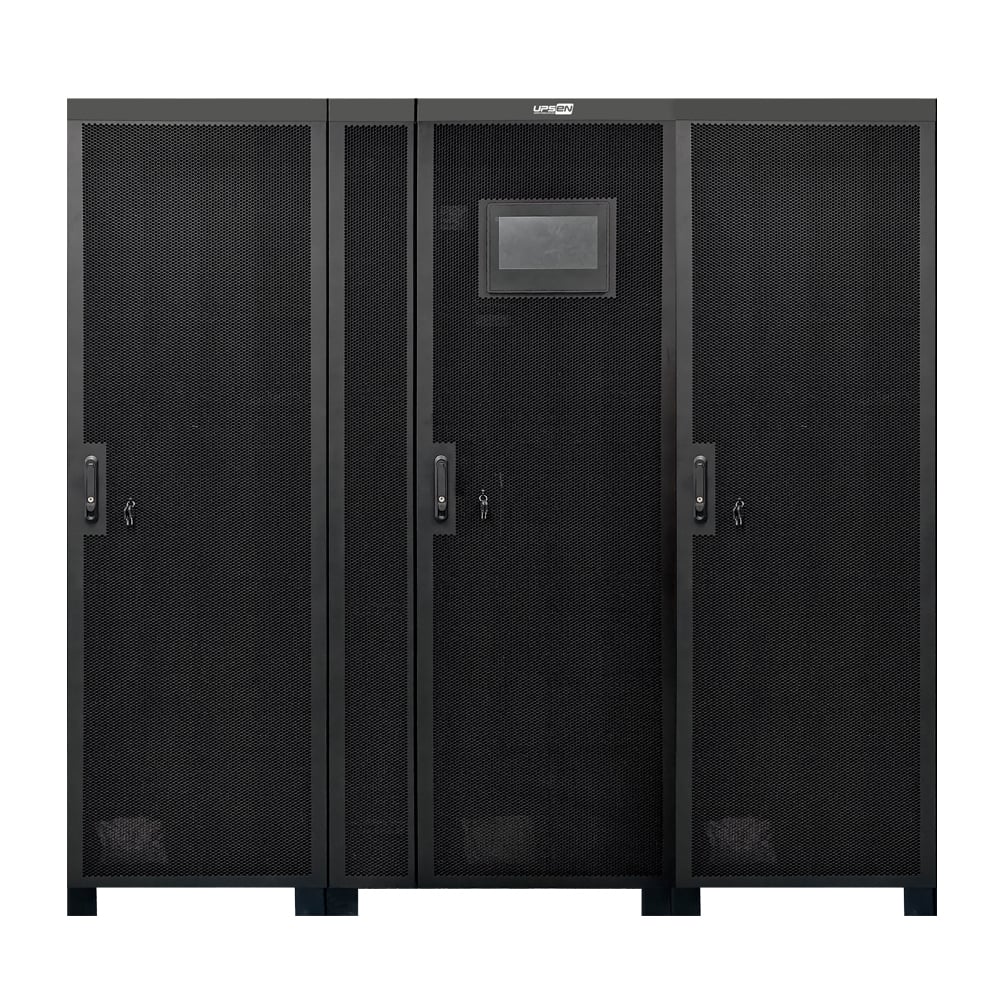
When you graduate from protecting a server room to protecting an entire facility—a data center floor, a hospital complex, a semiconductor fab—the UPS stops being a box in a corner and starts being a strategic asset. A failure at this level doesn't mean a few dropped transactions; it means lost batches, darkened operating theatres, regulatory fines, and front‑page news. The Melody Star Series is built for that kind of exposure. It's a modular online UPS that picks up where the MS Series leaves off, scaling from 100kVA to a frankly enormous 1.2MVA. If your power bill is measured in megawatts, this is the platform you build on.
Wide Input, Zero Derating at High Voltage
Utility voltage in industrial parks and dense urban grids often runs hot. Many UPS units begin pulling back their rated power when the input climbs above a certain threshold—quietly derating themselves just when you need full capacity. The Melody Star doesn't play that game. Its input window spans 138 to 485Vac line-to-line, and above 305Vac it still delivers 100% rated power. No capacity penalty, no fine print. That wide window also keeps the rectifier online during deep brownouts, saving the battery for actual blackouts instead of cycling it every time the grid sags.
Efficiency That Adds Up to Real Money
At megawatt scale, every fraction of a percentage point in efficiency counts. The Melody Star runs at 96.5% in double-conversion mode, thanks to a three-level inverter topology that reduces switching losses. Input power factor is better than 0.99, meaning the UPS draws current cleanly and doesn't dump harmonics back into the facility's electrical infrastructure. Across a 1MVA system running 24/7, a couple of efficiency points translate into tens of thousands of dollars saved annually in direct electricity costs and reduced cooling load. That's not marketing gloss—it's a line item on the facilities budget that gets smaller year after year.
Parallel for Redundancy, Common Batteries for Savings
You can run up to six Melody Star units directly in parallel. No centralised bypass cabinet, no proprietary sync box—the modules handle load sharing and fault isolation among themselves. And here's where the money gets interesting: they can share a single common battery bank. Instead of buying and maintaining separate battery strings for every UPS frame, you invest in one pool. Fewer cells to test, fewer cabinets to house, and a dramatically lower upfront battery cost when you're building out N+X redundancy at the multi-hundred-kVA level. In a 1.2MVA installation, that shared battery decision alone can save you the cost of a small house.
Battery Configuration That Adapts to Your Runtime
The number of cells in the battery string is adjustable from 30 to 50, giving you direct control over DC bus voltage and runtime. Need 10 minutes of backup? Thirty cells might do. Need enough autonomy to ride through a prolonged generator start-up? Push the count up. Each power module packs its own high-capacity charger, so even large battery banks don't require external chargers cluttering the installation. You're not locked into a rigid cell count dictated by the UPS.
Load Handling That Would Make a Transformer Blush
Output power factor is 0.9, so a 100kVA unit delivers 90kW of real power. But the real story is how it handles unruly loads. The Melody Star carries 100% unbalanced loading—you can pull the full rated power from a single phase while the other two idle, and the output voltage won't budge. It also drives pure inductive loads (motors, transformers, large contactor coils) close to full rated capacity without the waveform sagging or the inverter tripping into bypass. In a mixed-use facility where the UPS might be feeding production machinery alongside server racks, this tolerance eliminates the usual derating games and phase‑balancing acrobatics.
Generator-Friendly, with Power Walk-In
A big UPS can draw an enormous inrush current when it first powers up—enough to stall a generator or trip upstream breakers if not managed. The Melody Star's Power Walk-In function gradually ramps up the rectifier draw after an outage, giving the generator time to stabilize. You don't have to oversize the genset just to survive the UPS startup. For facilities that rely on generators during extended blackouts, this single software feature prevents one of the most common and costly headaches in backup power design.
LBS Synchronization for Dual-Bus Architectures
If your site is designed with two independent power paths—a dual-bus topology that feeds critical loads from two separate UPS systems—the Load Bus Synchronization (LBS) function keeps both Melody Star systems locked in phase. That means a transfer between buses, whether planned or fault-driven, happens with no phase-mismatch current spike. It's a feature that enables truly resilient distributed redundancy without a centralised switchgear single point of failure.
Management That Talks to Your Building
The Melody Star comes with a full suite of communication interfaces: RS485, SNMP, dry contacts, and CAN. Whether your building management system expects Modbus, your NOC demands SNMP traps, or your industrial controllers talk CAN, the UPS integrates without protocol converters or middleware. At this power level, you're not tucking the UPS in a corner and forgetting about it—you're actively monitoring it as part of the facility's central nervous system. The Melody Star gives you the data streams to do that.
Where the Melody Star Earns Its Place
This is a UPS for the top tier of power protection, where downtime is measured in millions of dollars per minute and the load is measured in megawatts:
`Hyperscale and colocation data centers that need scalable, redundant, high‑efficiency power
`Large hospital complexes where patient safety depends on absolute power continuity
`Semiconductor fabrication plants where a voltage wobble scrapped millions in wafers
`Financial trading floors and banking data centers where milliseconds matter
`Broadcast centres and telecom hubs that can't go dark, ever
`Industrial campuses with mixed IT and heavy mechanical loads
The Melody Star Series doesn't replace the MS Series—it extends the same DNA upward. Same three-level topology, same DSP control, same battery-sharing smarts, same tolerance for abuse. Just scaled to the point where you stop counting kilowatts and start thinking in megawatts. If your facility has outgrown the capabilities of a standard modular UPS, this is the platform that grows with you—one power module at a time, all the way to 1.2MVA.

1409-1410, Tongfang Center, the intersection of Zhongxin Rd. and Haoxiang Rd., Xinqiao St., Bao'an Dist., Shenzhen, China.
Copyright © Shenzhen UPSEN Electronic CO., LTD. All Rights Reserved Privacy Policy
 EN
EN