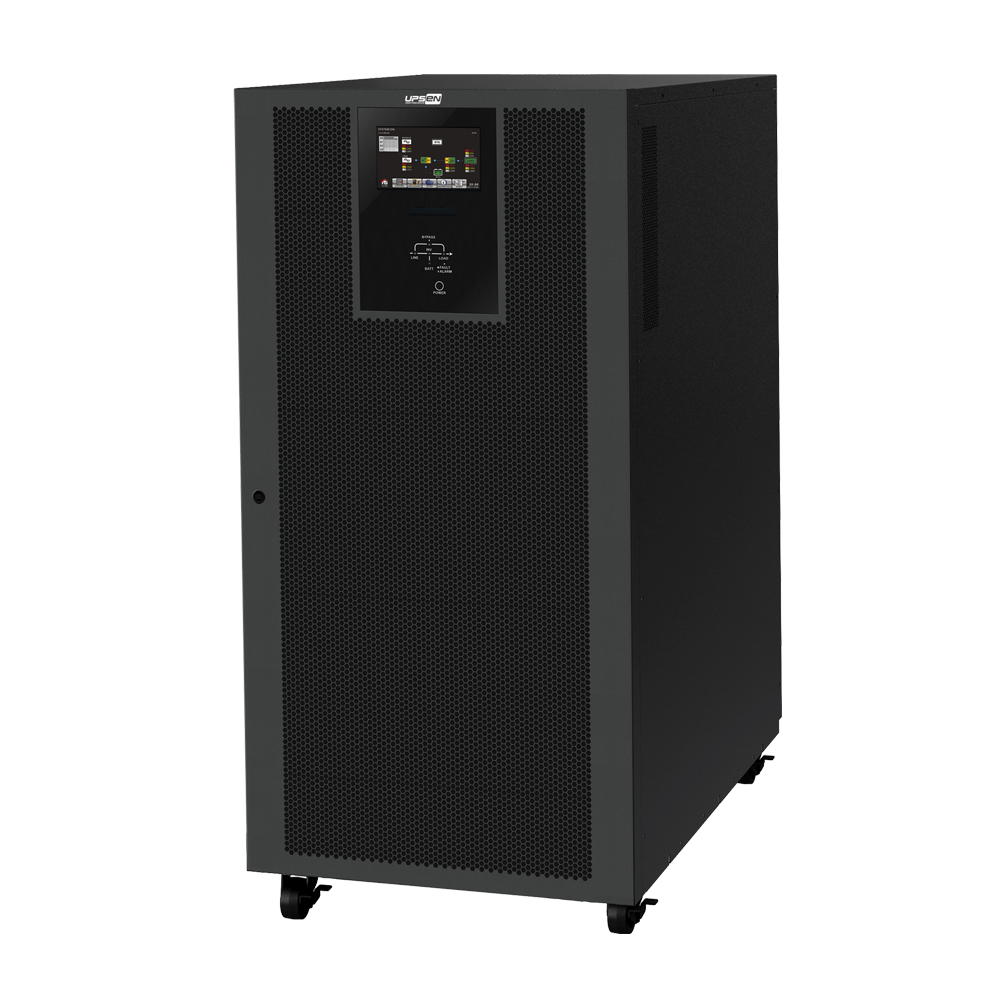
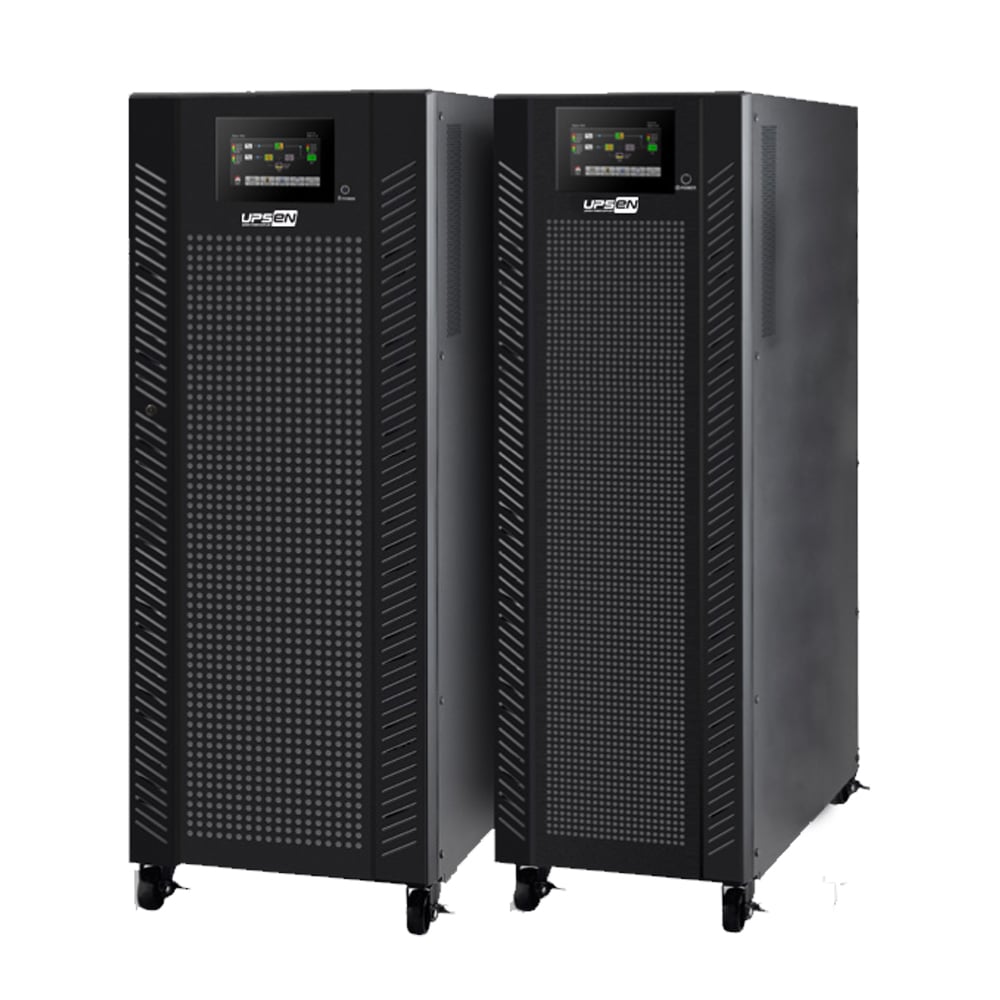
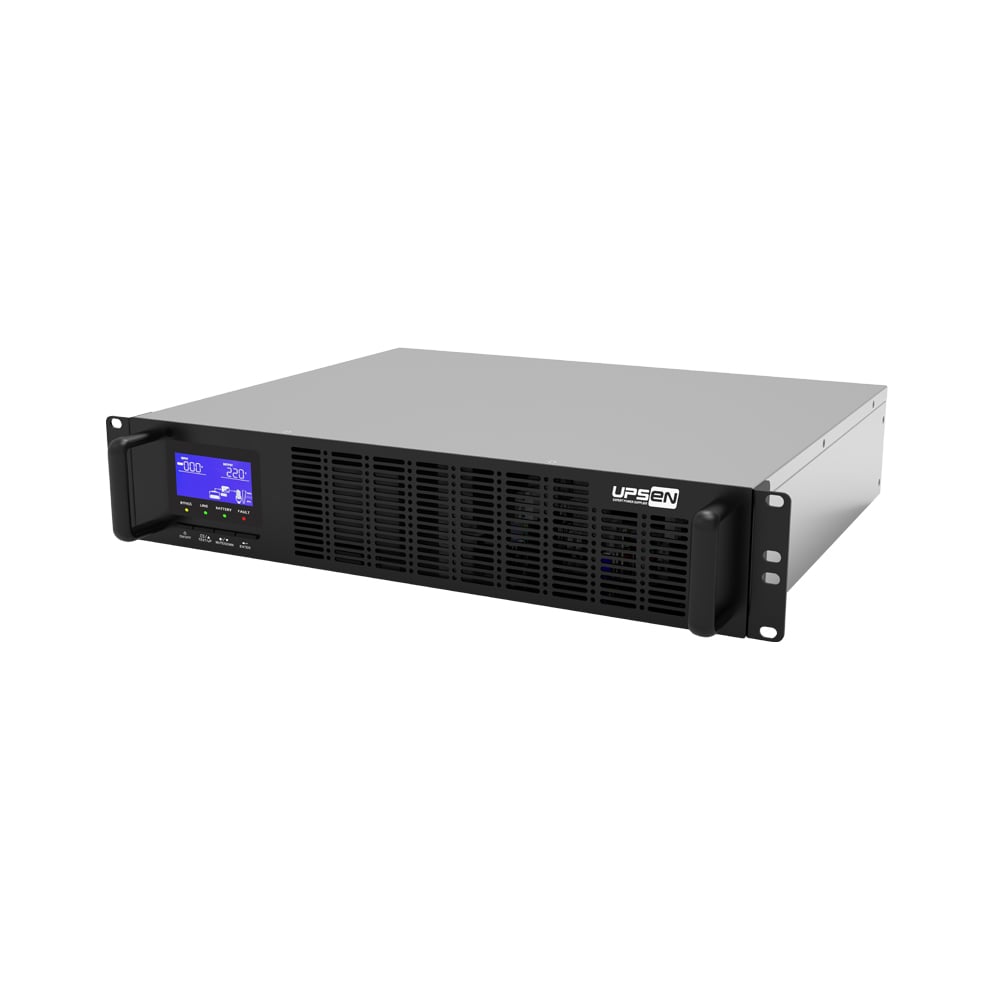
· Pluggable power module design with front access to decrease MTTR, parallel redundancy capability for power guarantee
· Parallel operation with common battery
· Power walk-in function
· Dual-mains inputs
· Built-in 4 switches including Mains input, bypass input, output and maintenance bypass switch
· Flexible battery configuration and adjustable charging current
· Output power factor 1
· Active power factor correction in all phases
· Built-in 7" touch LCD screen for comprehensive information
· Emergency power off function(EPO)
· Generator compatible
· 50Hz/60Hz frequency converter mode
| ES33 Fortress Series | ||||||||
| Model | 60K | 80K | 100K | 120K | 180K | 200K | 240K | 300K |
| Phase | 3-phase in / 3-phase out | |||||||
| Cabinet Capcity | 60KVA/60KW | 80KVA/80KW | 100KVA/100KW | 120KVA/120KW | 180KVA/180KW | 200KVA/200KW | 240KVA/240KW | 200KVA/200KW |
| Battery Type | External Battery | |||||||
| Parallel Capability | 4 | |||||||
| INPUT | ||||||||
| Nominal Voltage | 3 * 380 / 400 / 415 VAC (3Ph+N) | |||||||
| Voltage Range | 110-300 VAC @ 50% load; 176-276 VAC @100% load | |||||||
| Nominal Frequency | 50 / 60Hz (Auto sensing) | |||||||
| Frequency Range | 40Hz ~70Hz | |||||||
| Power Factor | ≧ 0.99 @ 100% load | |||||||
| Harmonic Distortion (THDi) | < 5% at full linear load | < 4% at full linear load | ||||||
| OUTPUT | ||||||||
| Nominal Voltage | 3 * 380 / 400 / 415 VAC (3Ph+N) | |||||||
| Voltage Regulation (Steady state) | ≦ ± 1% Typical (balanced load); ≦ ± 2% Typical (unbalanced load) | |||||||
| Nominal Frequency | 50 / 60Hz | |||||||
| Frequency Range(Synchronized range) | 46Hz ~ 54Hz or 56Hz ~ 64Hz | |||||||
| Overload Capability | ≦ 110% for 1 hour, 111% ~ 125% for 10 mins, 126%~150% for 1 min and >150% for 200ms | |||||||
| Harmonic Distortion | ≦ 2% THD (Linear Load) ; ≦ 4% THD (Non-linear Load) | |||||||
| EFFICIENCY | ||||||||
| AC Mode | 95.0% | 95.5% | ||||||
| ECO Mode | 98.0% | 98.5% | ||||||
| Battery Mode | 94.0% | 94.5% | ||||||
| BYPASS | ||||||||
| Nominal Voltage | 3 * 380 / 400 / 415 VAC (3Ph+N) | |||||||
| Voltage Range | -30% ~ +20% | |||||||
| Frequency Range | 46Hz ~ 54Hz or 56Hz ~ 64Hz | |||||||
| Overload Capability | ≦ 110% for 1 hour, 111% ~ 125% for 10 mins, 126%~150% for 1 min and >150% for 200ms | |||||||
| BATTERY / CHARGER | ||||||||
| Nominal Voltage | +/- 192V ~ +/- 240V (Selectable) | |||||||
| Maximum Voltage | +/- 240V (12V x 40 Pcs) | |||||||
| Minimum Voltage | +/- 192V (12V x 32 Pcs) | |||||||
| Floating Charge Voltage | 2.28V / Cell (2.25 ~2.33 Selectable) | |||||||
| Boost Charging Voltage | 2.35V/Cell | |||||||
| Temperature Compensation | Yes | |||||||
| Maximum Charging Current (Per Power Module) |
18A (Adjustable) | 24A (Adjustable) | 24A (Adjustable) | 36A (Adjustable) | 54A (Adjustable) | 54A (Adjustable) | 72A (Adjustable) | 90A (Adjustable) |
| PHYSICAL | ||||||||
| IP Class | IP20 | |||||||
| Machine Dimensions,D*W*H (mm) | 1000*320*800 | 1000*430*1200 | 1000*430*1200 | 1000*430*1200 | 1000*600*1200 | 1000*600*1200 | 1100*600*1475 | 1100*600*1475 |
| Net Weight (Kgs) | 94 | 169 | 169 | 169 | 249 | 249 | 360 | 396 |
| ENVIRONMENT | ||||||||
| Operating Temperature | 0 - 40℃ | |||||||
| Operating Humidity | < 95 % and non-condensing | |||||||
| Altitude | <1000m for Nominal power | |||||||
| MANAGEMENT | ||||||||
| Smart RS-232/USB | Supports Windows,Family, Linux and MAC | |||||||
| Optional SNMP | Power management from SNMP manager and web browser | |||||||
| STANDARDS | ||||||||
| Safety | IEC/EN 62040-1 | |||||||
| EMC | IEC/EN 62040-2 Category C3 | |||||||
| *If the UPS is installed or used in a placewhere the altitude is above than 1000m, the output power must be derated one percent per 100m. *Product specifications are subject to change without further notice. |
||||||||
Front-Access Power That Won't Make You Wait
When a UPS module fails in a live data center at two in the morning, the last thing you want to hear is that someone has to pull the whole unit out of the rack just to swap a power cell. That's downtime you don't have, and it's the exact scenario the ES33 Fortress was designed to prevent.
This is a high frequency online UPS built around a simple idea: all the active power modules are front-accessible and pluggable. If a module throws a fault, you slide it out from the front, slide a new one in, and keep moving. The repair clock stops in minutes, not hours. For a 300kVA system protecting an entire production line or a hospital wing, that kind of service speed isn't a luxury—it's the whole point.
Modular Inside, Not Just on the Nameplate
Plenty of UPS units call themselves modular because they can be paralleled. The Fortress takes it deeper. The power modules themselves are self-contained, hot-swappable units inside the main chassis. They share the load, and if one goes offline, the others automatically pick up the slack. This is N+X parallel redundancy working at the module level, right out of the box. You can lose a module and still have full rated protection. No single point of failure takes the system down.
And when you need more capacity later, you don't replace the whole UPS. You add more modules to the chassis, up to the frame's limit. Scale on your timeline, not the vendor's.
Common Battery, Uncommon Savings
If you're running multiple UPS frames in parallel, the Fortress lets them share a single battery bank. No need for isolated strings per unit. That one decision cuts your battery investment substantially—fewer cabinets, fewer cells to maintain, and a smaller footprint in the battery room. When you're dealing with the kind of energy storage a 300kVA system demands, those savings are real money.
Power Walk-In: Gentle on Generators
Here's a scenario every facility manager learns to dread: utility power returns after a long outage, the UPS tries to restart and charge its batteries all at once, and the sudden inrush current either trips the upstream breaker or sends the generator into a fit. The Fortress has a power walk-in function that prevents exactly that. After a blackout, it gradually ramps up the rectifier load instead of slamming the source. Your generator stabilises, the breakers stay happy, and the site comes back online in a controlled sequence. It's one of those features that does nothing 99% of the time and saves your night the other 1%.
Dual Inputs, Built-In Bypass, No External Panels
Redundancy isn't just about how many modules are spinning. The Fortress supports dual-mains inputs as standard—connect two independent utility feeds, or one utility and one generator. If one source fails, the UPS draws from the other without blinking.
And the maintenance bypass? It's built right into the frame. Four integrated switches—mains input, bypass input, output, and maintenance bypass—let you isolate the entire UPS for service while your load continues to run on raw utility or generator power. No external bypass cabinet to spec, no wall of breakers to label, no electrician squinting at a wiring diagram at 3 a.m.
Output Power Factor 1.0: What You See Is What You Get
A 300kVA UPS with a 0.9 power factor gives you 270kW. The Fortress gives you 300kW—output power factor of 1.0. For modern server racks with near-unity power factor power supplies, that means you're using every amp you paid for. No hidden derating, no capacity left on the table because of a legacy PF rating.
Active Power Factor Correction on All Three Phases
On the input side, active PFC keeps each phase's power factor at 0.99 and harmonic distortion low. The UPS pulls clean current from the grid, which keeps your upstream transformers cool and avoids the kind of neutral overheating that haunts older buildings with lots of electronic loads. It's good power citizenship, and it shows up on the electric bill over time.
Battery Configuration That Adapts to Your Runtime
Need longer runtime? Want to use a specific battery chemistry? The Fortress lets you adjust both the number of cells and the charging current. You're not locked into a rigid string configuration dictated by the UPS. Match the battery bank to your actual needs, whether that's 10 minutes to generator start or an hour of full-load autonomy.
A 7-Inch Touchscreen That's Actually Usable
Most UPS displays are afterthoughts—tiny text, nested menus, cryptic icons. The Fortress has a 7-inch touch LCD that shows phase voltages, currents, load percentages, battery status, and alarm logs all on one screen. It's big enough to read from across the room, and the interface is laid out so you don't need the manual to find what you're looking for. If you've ever tried to interpret a fault code on a 2-line display while an alarm is beeping, you'll understand why this matters.
EPO and Hardened Options
Emergency Power Off is standard—hard-wired button or remote signal to kill output instantly when safety demands it. No software layers, no delay.
For harsh environments, the Fortress can be equipped with dust-proofing, lightning protection, and conformal coating on the boards. It's a big machine, but it doesn't need a pristine data hall to survive. Generator compatibility is solid; the wide input window tolerates the kind of sloppy output that makes lesser UPS units refuse to sync.
Reliability Numbers That Back Up the Name
Mean Time Between Failures is rated at over 200,000 hours. When service is needed, the front-access module design drops Mean Time To Repair under 30 minutes. These aren't just numbers on a datasheet. They translate into fewer service calls and faster recovery when something does happen. For a 24/7 facility, that's the difference between a scheduled intervention and a major event report.
Where the Fortress Belongs
The ES33 Series Fortress is for sites where the UPS can't be the weak link: hospital operating suites, data center halls, semiconductor fabs, transit control rooms, industrial process lines. If you're in the 60–300kVA range and need a system that can be serviced fast, scaled without a forklift, and trusted to run for a decade, this is the box you spec.
It's a high frequency online UPS that delivers the maintainability of a modular platform without the price tag of a low-frequency transformer design. Front-access modules, built-in bypass, parallel scalability, and a 1.0 power factor—all in a chassis that your service team will actually thank you for choosing.

1409-1410, Tongfang Center, the intersection of Zhongxin Rd. and Haoxiang Rd., Xinqiao St., Bao'an Dist., Shenzhen, China.
Copyright © Shenzhen UPSEN Electronic CO., LTD. All Rights Reserved Privacy Policy
 EN
EN